


Bologna
-the red, the learned, and the fat-

The soul of the city
Bologna is famous for its three extraordinary nicknames: the Learned (la dotta), because the oldest university in the world was founded here; the Red (la rossa), a symbol of Italian communism and the characteristic tiles and bricks that color its roofs and facades; and the Fat (la grassa), as the capital of Italian gastronomy.
This vibrant city is a major center for culture, art, and international trade fairs. Bologna is the city of majestic towers, hidden medieval canals, and porticoes that stretch for almost 40 kilometers. In 2021, the porticoes of Bologna were recognized as a UNESCO World Heritage site.
But Bologna is not just about monuments and excellent food: here, it’s the people who truly matter. The welcoming and friendly atmosphere allows anyone to feel at home and be captivated by a fascinating blend of history, culture, and gastronomic passion.
Itinerary
Duration
2,5 ore
Meeting point
Piazza Maggiore
Step 1
The beating heart of historic Bologna
Palazzo Comunale
Majestic complex that once housed the papal legates, today a symbol of the city’s institutions and home to a museum.
Palazzo del Podestà
The oldest building on the square, where the Bolognese administration took its first steps.
Palazzo Re Enzo
Built in the 13th century, it was for a long time the prison of King Enzo of Swabia.
Palazzo dei Banchi
The seat of medieval bankers and the financial center of the city.
Palazzo dei Notai
An elegant 14th-century palace, home for centuries to the esteemed guild of notaries.

Step 2
Basilica di San Petronio
The largest and most important place of worship in Bologna, dedicated to the city’s patron saint. Its monumental facade and splendid interiors, including the Chapel of the Bolognesi and the famous Cassini Meridian, testify to the power and prestige of ancient Bologna.
Step 2
Nettuno
We will then reach Piazza del Nettuno, dominated by the majestic Fountain of Neptune, an imposing bronze statue of the god of the sea, a symbol of the city and the inspiration for the famous logo of the Maserati car brand.
Step 3
The Ancient University and the Archiginnasio
Following the elegant Portico Pavaglione, we will arrive at the Palazzo dell’Archiginnasio, the first historical seat of the University of Bologna. Commissioned in the 16th century to gather the scattered faculties of the Studium, the building stands out for its monumental loggia. Here we will be enchanted by the 16th-century courtyard decorated with thousands of student coats of arms, a heraldic mosaic unique in the world that bears witness to centuries of alumni passing through from all over Europe.
Continuing to the upper floors, we will be fascinated by the evocative Anatomical Theatre, the ancient dissection room for medical students. It is entirely carved in fir wood and dominated by the professor’s chair, which is flanked by the famous statues of the “Spellati” (the skinned ones), striking monuments to Baroque scientific research.

Step 4
Gastronomy and the Two Towers
Culinary experiences will certainly not be missing: in the Mercato di Mezzo district, we will taste local specialties such as tortellini, mortadella, and torta di riso (traditional rice cake), an authentic feast for the palate.
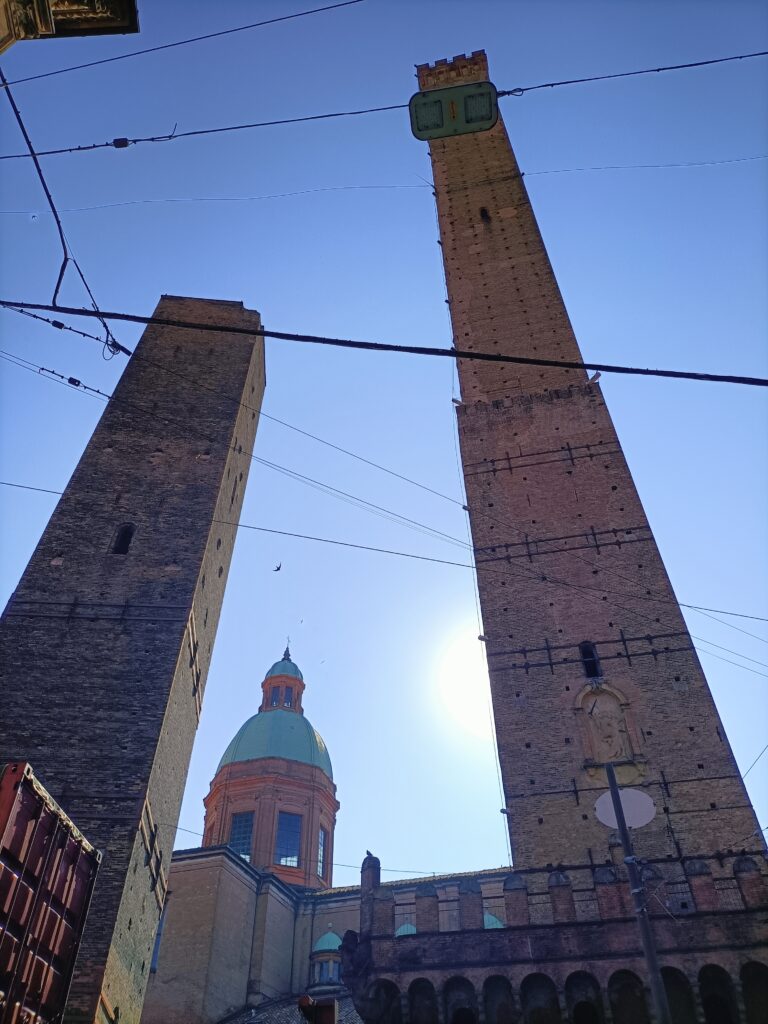
We will conclude our walk at the Palazzo della Mercanzia, an elegant Gothic building that today houses the Chamber of Commerce, a symbol of Bologna’s ancient commercial power, and the iconic Two Towers (Due Torri), medieval towers that still fascinate today with their unique shape and millennial history.
More attractions
The complex of the Seven Churches (Sette Chiese), a legendary place that houses the remains of a pagan temple dedicated to the Egyptian goddess Isis and an extraordinary copy of the Holy Sepulchre.
Basilica di Santo Stefano
The burial place of Saint Dominic, featuring a funerary monument crafted by great masters such as Nicola Pisano, Nicolò dell’Arca, Alfonso Lombardi, and a young Michelangelo.
Basilica di San Domenico
A Renaissance pearl with walls decorated by magnificent frescoes painted by local artists.
Oratorio di Santa Cecilia
A Baroque church situated on one of the Apennine hills, housing the miraculous icon of the Madonna di San Luca, a pilgrimage destination for centuries. The basilica is reached via the longest portico in the world, stretching for 4 kilometers, making the walk itself an unforgettable experience.